Fuzzy Relative Willingness: Modeling Influence of Exogenous Factors in Driving Information Propagation Through a Social Network

Abstract
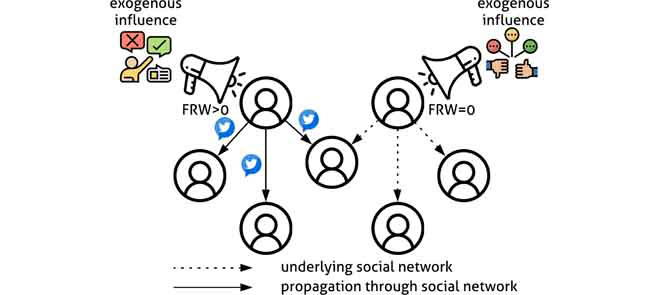
A high percentage of information that propagates through a social network is sourced from different exogenous sources. E.g., individuals may form their opinions about products based on their own experience or reading a product review, and then share that with their social network. This sharing then diffuses through the network, evolving as a combination of both network and external effects. Besides, different individuals (nodes in a social network) have different degrees of exposition to their external sources, as well. Modeling this influence of external sources is important in order to understand the diffusion process and predict future content sharing patterns. Recognizing this fusion of intrinsic (network) effect and exogenous (external) effect, this paper develops a novel fuzzy relative willingness (FRW) model. Leveraging a fuzzy set approach provides a way to handle the uncertainties arising within the human concept of willingness. We demonstrate that FRW is able to accurately identify both top-k most content producers and diffusion effect based on external influence. We also demonstrate that the fuzzy set theory provides a compelling framework to model uncertainties pertaining to the influence as well as the susceptibility of individuals for both network and exogenous effects.
Type
Publication
IEEE Access
